
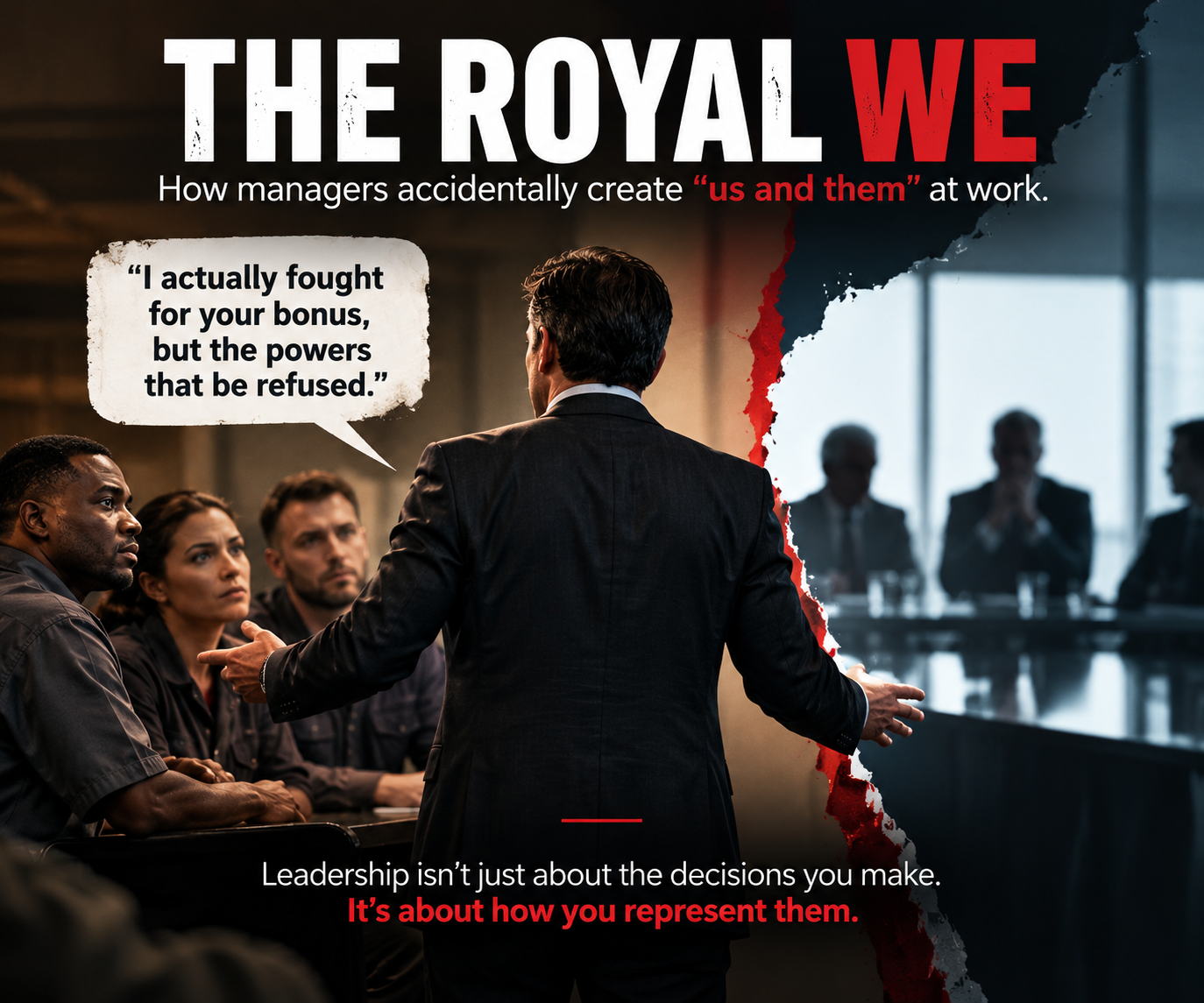
How much time do organisations actually spend teaching managers what it means to speak with one voice?
There is a strange contradiction in management.
We expect managers to represent the interests of the organisation, implement its decisions, manage employees fairly and consistently, and take responsibility for the people they lead.
At the same time, many managers believe that being a good manager means being popular with their employees.
That is where things can start to go wrong.
The manager who wants to be everyone's friend
Most organisations have encountered this manager.
They are the manager who sits with employees and complains about management.
They sympathise with every grievance.
They distance themselves from unpopular decisions.
And sometimes they say things like:
It sounds supportive.
It sounds like the manager is fighting for their people.
But what has actually happened?
The manager has created two camps.
Us.
And them.
The employee now sees their manager as an ally against an organisation that supposedly makes unreasonable decisions.
And the next time management makes a decision the employee doesn't like, the response is predictable:
But where did that allegiance come from?
The manager helped create it.
If you are a manager, you are management
This is the uncomfortable part.
Once you accept a management position, you become part of the management structure.
You don't stop being management because you're sitting in the smoking area with your employees.
You don't stop representing the organisation because you disagree with a decision.
And you shouldn't use an organisational decision to make yourself look like the employee's champion against "the people upstairs."
That doesn't mean managers should blindly agree with everything.
Quite the opposite.
Good organisations need managers who challenge decisions.
They should question assumptions.
They should argue for their employees.
They should present alternative solutions.
They should tell senior management when they think a decision is wrong.
They should fight hard for what they believe is right.
But there is a place for that conversation.
The management room.
Challenge privately. Communicate consistently.
There is nothing wrong with a manager saying:
In fact, I'd be more concerned about a management team where nobody ever says it.
The problem starts when the manager takes that disagreement back to the employees and says:
Now the manager has changed the relationship.
They are no longer simply communicating a decision.
They are recruiting employees into an internal management disagreement.
The organisation now has competing political factions.
And employees quickly learn which managers will tell them:
and which managers will tell them:
There is a massive difference.
One communicates organisational authority.
The other undermines it.
The power of the Royal We
This is where language becomes surprisingly important.
Consider these two statements:
versus:
The decision hasn't changed.
The bonus hasn't changed.
But the relationship has.
The first statement creates distance:
Management versus You.
The second creates alignment:
We.
That is the Royal We.
It isn't about pretending that every manager personally agreed with every decision.
It is about recognising that, once a legitimate management decision has been made, the manager has a responsibility to communicate that decision as part of the management team.
Instead of:
Say:
Instead of:
Say:
Instead of:
Say:
The employee may still be disappointed.
They may still disagree.
They may still challenge the decision.
But the manager hasn't positioned themselves as an opponent of the organisation.
Language creates allegiance.
This is not about suppressing disagreement
This distinction is important.
Speaking with one